

The map
mapdiffUntick Changes to see the repository as it is, with nothing drawn over it.
Reading it
Section titled “Reading it”Boxes are code: a directory holds files, a file holds types and functions, a type holds its members. A wire runs from what uses to what is used, and the layout flows the same way, left to right. A number on a wire is how many references it stands for.
| Wire | Means |
|---|---|
| Solid, with an arrowhead | Uses |
| Dashed, in another colour | Uses, but against the flow: this wire closes a loop |
The bar above the map says how the wires were found: References: by name or by type. By name misses methods called on a value; Index next to it adds them. See languages and references.
Levels
Section titled “Levels”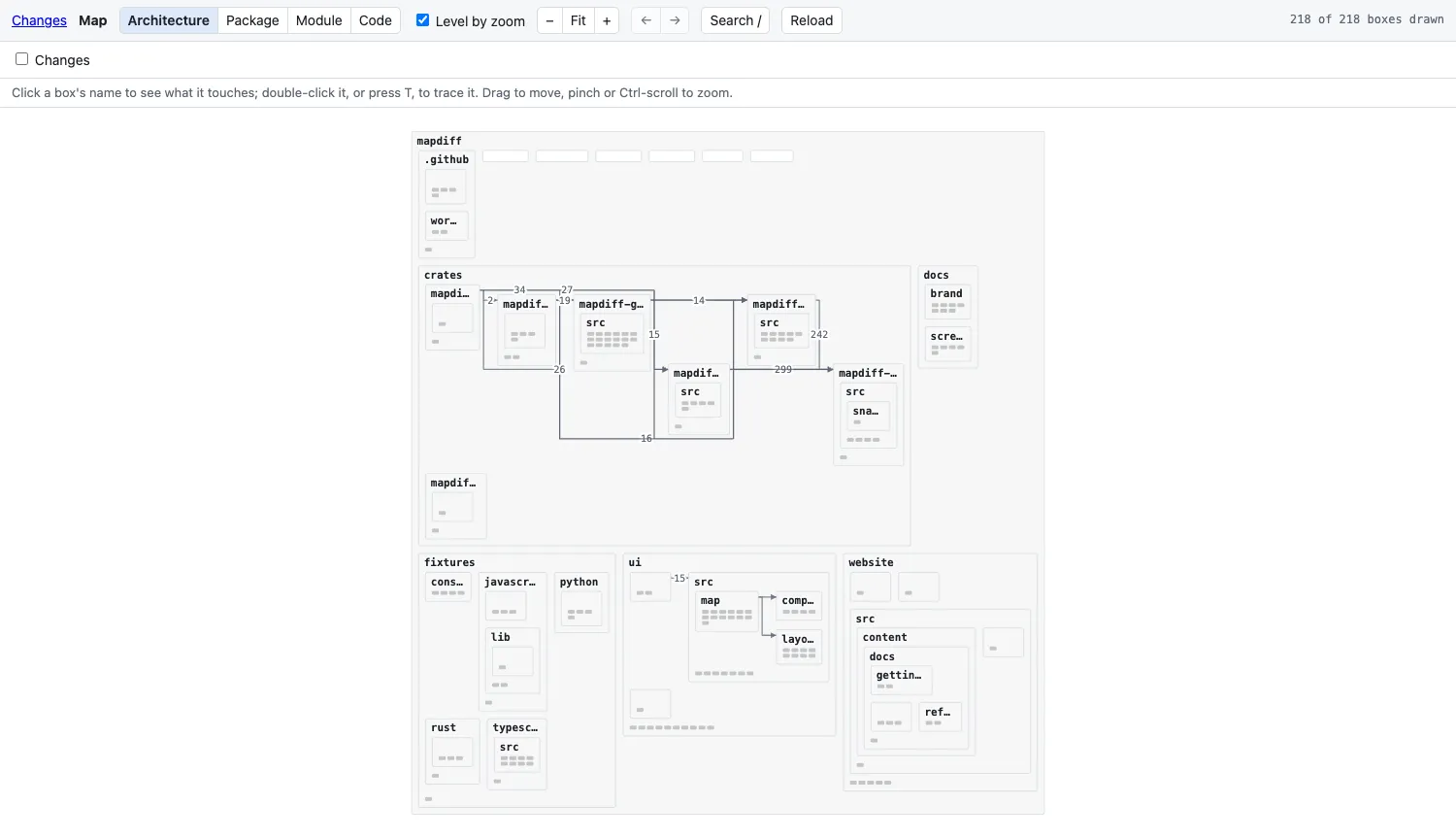
| Level | Key | Shows |
|---|---|---|
| Architecture | 1 |
Directories and the wires between them. Files are small marks |
| Package | 2 |
Files |
| Module | 3 |
Types and functions |
| Code | 4 |
The text of every function |
Zooming far in on a box that only shows its title opens the next level around it. Zooming far out goes back. Untick Level by zoom to switch only by key.
Selecting
Section titled “Selecting”Click a box. When a box shows code, click its title bar (clicking the code selects text). The map then:
- lights the boxes that use it and the boxes it uses,
- draws a path to each, across files and directories,
- dims everything else.
The panel on the right has the same as two lists, Used by and Uses, with the line where each use happens. Click one to go there.
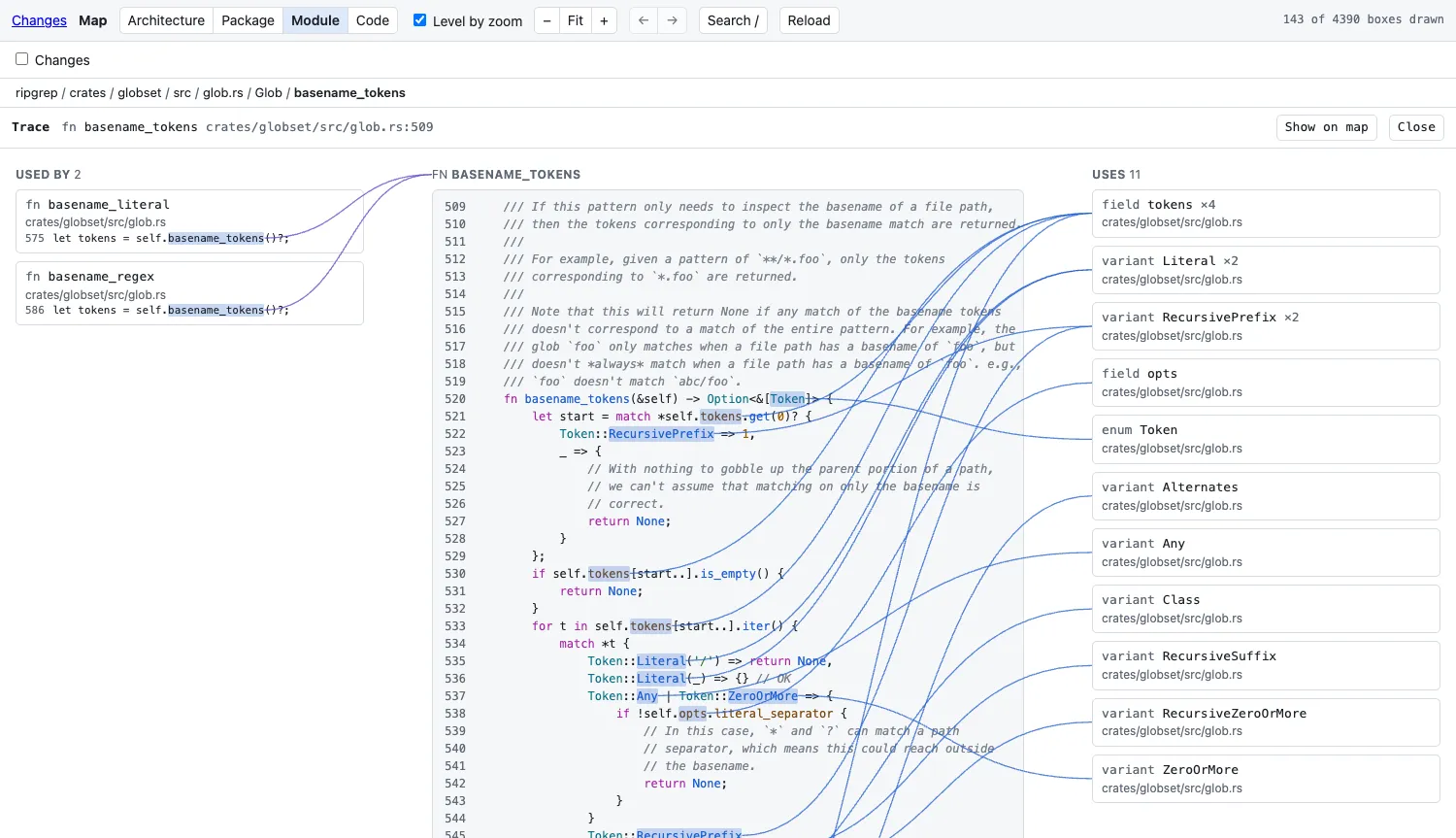
T, the Trace button, or a double-click on a title. One function in the middle, its callers on the left with the lines that call it, what it calls on the right, and a curve from each name in the code to what it refers to. Click a card to trace that one.
Finding things
Section titled “Finding things”/ or Cmd-K, then a few letters: wkb finds WalkBuilder. Enter jumps to it and changes level if the map is not showing that kind of thing. [ and ] go back and forward through what you selected.
Long functions
Section titled “Long functions”A code box shows 40 lines. Its last line, … 21 more lines (show all), opens the rest in place. For anything long, Trace is the better place to read.